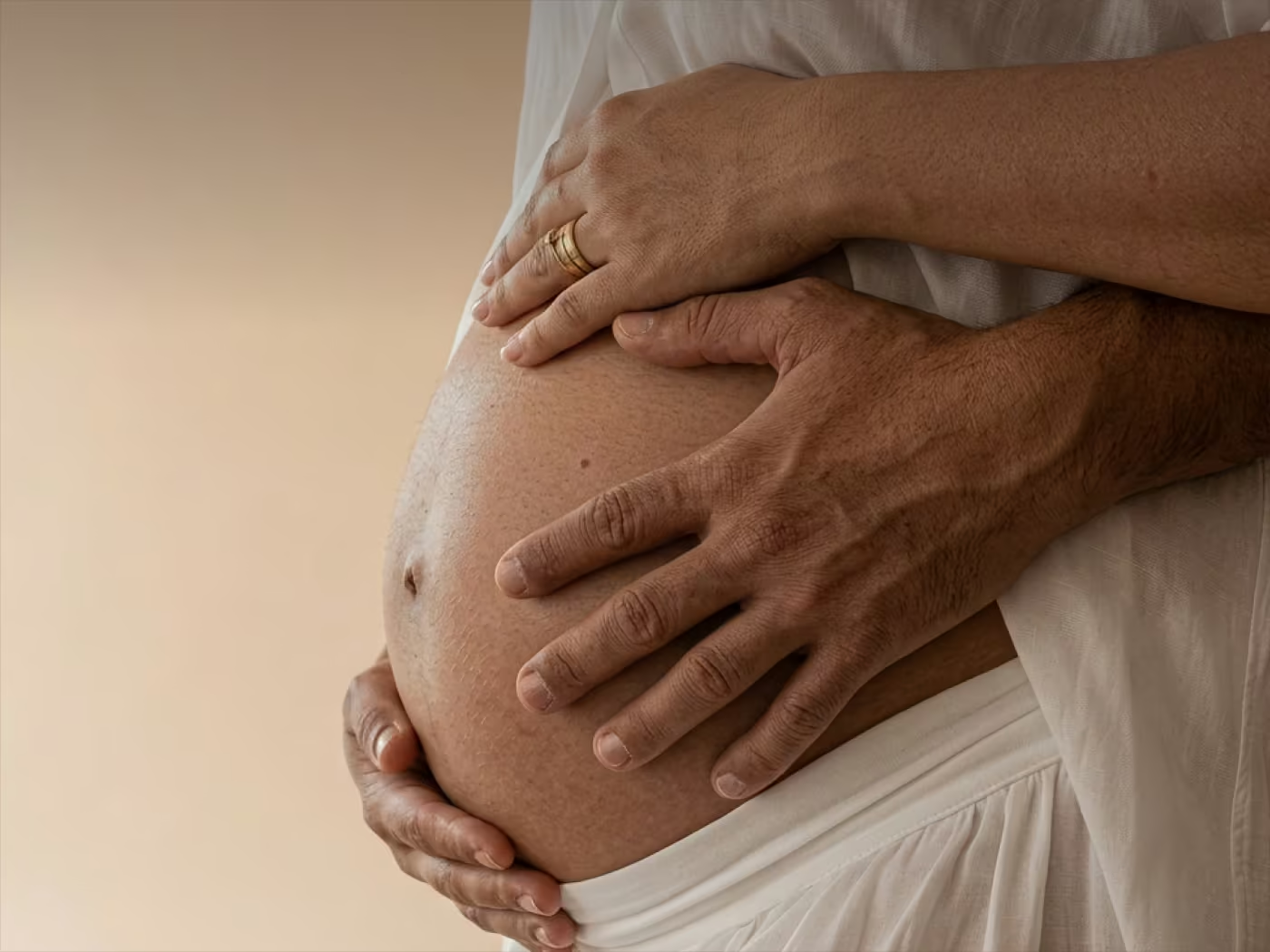
The route to parenthood for LGBTQ+ community may look very different depending on your fertility status and where you are in your journey.
For some, it involves donor sperm and a straightforward cycle of IUI. For others, it involves egg donation, surrogacy, or fertility preservation before gender-affirming treatment.
A consultation with a doctor who understands each of these paths is where it begins.

The right treatment depends on your anatomy, your partner’s anatomy (if you have one), and your fertility picture. Below is a guide to the main paths — each one is explained in more detail further down the page.

IUI with donor sperm, IVF with donor sperm, or reciprocal IVF (where one partner provides eggs and the other carries the pregnancy).

Surrogacy with egg donation, using one or both partners’ sperm. Medical history and sperm assessment are the starting points.

Options depend on your anatomy. Single women may use donor sperm for IUI or IVF. Single men may pursue surrogacy with egg donation
Fertility preservation before hormone therapy or surgery, or conception options depending on anatomy and current treatment. A consultation with a doctor is the first step.
Plan Your Baby™ is the only fertility clinic in the UK offering IVF and fertility treatments built around your lifestyle, supported by a holding-hand approach so you never face your journey alone.

There are three main treatment paths for female same-sex couples. Which is most appropriate depends on your fertility picture, your fallopian tube health, and whether both partners want to be biologically involved in the pregnancy.
A doctor consultation — with a full review of both partners’ fertility — is the first step.
For male same-sex couples, the path to parenthood can be adoption or involve surrogacy and egg donation. This is a longer and more complex process than IVF — it involves coordinating between legal, medical, and personal decisions.
A doctor consultation — with a full review of both partners’ fertility — is the first step.
Choosing to become a parent without a partner is a decision that comes with its own set of practical and medical questions. The treatment pathway depends on your anatomy and fertility picture. Here is an overview of the main options.
Fertility options for trans and non-binary people depend on your individual anatomy, whether you have started hormone therapy or had gender-affirming surgery, and what your goals are. This is an area where a consultation with a doctor — not a general assessment — is the right starting point.Below is an outline of the main situations we see. If yours is not described here, the same principle applies: book a consultation and bring what you know about your current treatment and your fertility goals.
%20(1).webp)
.webp)
%20(1).webp)
From your first consultation to same‑day results and treatment recommendations, we guide you through each stage of your fertility assessment.
.avif)

El.

T.
I am writing to say the MOST enormous thank you for everything that you did last summer to support me through my first trimester of pregnancy. I am completely over-the-moon to let you know that we welcomed little T. on 10th March. She has arrived healthy, happy, and utterly perfect (we're biased!).
I felt so well looked-after and reassured throughout what was a very anxious time. From our first call with Dr we were so relieved to have a 'plan' (albeit not one that we were expecting to need), and his guidance through the slightly murky world of RI was so valuable. To be able to be in touch with your incredible nurses (esp. Vivian), Dr Sami and Marija regularly made a huge difference, and nothing was too much trouble (even early pregnancy scans in Lisbon when we were on holiday!).
We feel unbelievably blessed to have the family of five that we dreamed of T.'s big brother and sister adore her, and we are soaking up every moment of these special newborn days. I won't hesitate to recommend PYB to anyone else who finds themselves in the same situation that we did.
THANK YOU.
.avif)
Sophie S.
Delilah Hazel and Etta Philippa
Sophie and I wanted to introduce you to the newest Spencers - Delilah Hazel and Etta Philippa born 3rd November just after 5pm weighing 5lb 12oz and 5lb 4oz.Thank you to you all for your support on this journey - you’ve made our dreams come true.
.avif)
Sophie P.
Flynn
Good morning. Just wanted to share our amazing news of baby Flynn's arrival on the 19th June, Thank you all for making this happen
.avif)
L. W.
V.
Finally, I'd just like to say that we've had a brilliant experience with everyone at Plan Your Baby and have felt so reassured during these early weeks, so thank you very much for that. Thanks, L.
.avif)
Lucy & Joe Wilding
Jude
Hello, I am just writing to let you know of the arrival of our baby Jude. He arrived to us 2 weeks early on the 15th April. We would like to thank you for helping us achieve our goals on our fertility journey. After 2 years of trying you made our dreams come true on the first attempt, which was more than we could have ever imagined. The staff and Dr Sami were all so informative and attentive. We couldn't have asked for anymore from you... Thank you a million times over. Best Wishes, Lucy & Joe Wilding
Abbey K.
Felix Cillian
I just wanted to share some news with the team. We used your services earlier this year for early pregnancy monitoring following recurrent miscarriages the previous year.
Our baby boy Felix Cillian was born in August at 38w+2, weighing 7lbs7ozs. He is absolutely wonderful and we are over the moon with our rainbow baby. We couldn’t have got here without the support of your clinic and we are incredibly thankful.
Please pass our thanks onto the whole team.
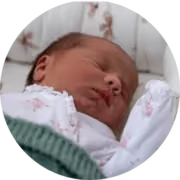
Lauren C.
Baby Cora Rose
The biggest thank you to Plan Your Baby for completing our family. They made us feel safe, supported & confident when our trust in the process had been completely destroyed. They also made us feel extremely well cared for & humanised in an industry that can make you feel like a number. I needed a lot of personal support & Marija was always there to give it to me. Dr Sami threw everything at this attempt, knowing it was our last & I am just so grateful that he took no chances with our care. I really felt his human investment in our family, it wasn’t that he wanted the numbers for his clinic, he wanted this baby for us. Thank you again to the PYB team. We are beyond grateful.

Lindsay G.
Baby Katie
Plan your baby provided us with support and reassurance at a very tricky time. Their early pregnancy monitoring was thorough and Marija was always quick to respond to any questions, worries or concerns. I had been looking for exactly what plan your baby offers, someone to guide you through the unknown of a new pregnancy after recurrent loss from the ease of your local area.

Victoria C.
Baby Innis
Since the first interaction with Dr Sami and Marija trying to conceive through to their early pregnancy support we wouldn't be staring at our beautiful 8 day old. Having previous miscarriage and struggles, when I finally saw those double lines I was left feeling anxious and terrified . Immediately, I got support throughout my first trimester and I truly do believe the plan in place meant she is here today. Couldn't be more grateful. Thank you Plan my Baby.

Abigail M.
Baby Rowan
I came to Plan Your Baby after a missed miscarriage, knowing I wanted to do everything I could to support my next pregnancy. I initially had advice on fertility testing, which was thankfully not needed as we conceived quickly the second time round.
I had support from PYB in the first 3 months of my pregnancy — regular blood tests and scans and medication to help the pregnancy. Marija and Dr Sami were supportive, knowledgeable and kind throughout the whole period, providing me with much needed emotional support, especially with some early bleeding in the first few weeks.
I wouldn't hesitate to recommend PYB, especially for the flexible, remote support aspect.
My little boy is here now, so thank you from the two of us.

Veronica E.
Baby Celine
I’m incredibly grateful for the support I received from Plan Your Baby during the early stages of my pregnancy. Their team was always available—no matter the time—to guide me, recommend trusted labs and professionals, and help me navigate this delicate and uncertain period with peace of mind.
One of the things that made a huge difference for me was the convenience of their at-home services, including blood collection and progesterone injections. It took a great weight off my shoulders during a time when rest and reassurance were so important.
I wholeheartedly recommend their services to anyone going through the early phases of pregnancy, especially after an embryo transfer. Their care and responsiveness made me feel calmer, more secure, and truly supported.
A very special thank you to Dr. Sami and Marija—without your dedication and kindness, my journey would have been much more difficult.

Aisling O’K.
Baby Teddy
We came to Plan Your Baby following a number of years of failed fertility treatments. From the start Marija and Dr Sami made us feel supported, heard and reassured. We felt immediately that PYB could be the people to help us have a baby. Throughout the IVF process they were always available to support us and we felt confident in their care.
Their unique approach to fertility treatment made IVF more accessible, less stressful and less of a burden when also trying to juggle work. Our son was born in May and we simply couldn’t be more grateful to them for getting us here.

Jade G.
Baby Vienna
Plan your baby have been amazing with me throughout my time with them and if it wasn’t for them I wouldn’t be 20 weeks in with my rainbow baby. There very attentive and fast with there replies and quick on helping with all your needs.
Deffo recommend plan your baby if you are struggling with getting pregnant and keeping babies there truly amazing and the support is unreal.
.avif)
Jonny C.
Baby Molly
Dr. Sami and his team were nothing short of incredible. They gave us clarity, care and hope when we were afraid to believe this pregnancy could work out. They are the reason we have our gorgeous girl, Molly.
Our fertility team brings together leading consultants, nurses, embryologists, and specialists in genetics, nutrition, and wellbeing — providing complete care at every stage of your journey.
Speciality Doctor in Fertility, Sexual and Reproductive Health · MBBS, MRCOG, MRCPI (O&G), DFSRH
Medical Director and Leading Fertility Consultant at Plan Your Baby™ MBBS, MRCOG
Nineteen years in embryology, from early PGT work in Chicago to senior laboratory practice at ARGC since 2006.
Clinical Lead for Hysteroscopy at King's Fertility and King's College Hospital, and RCOG preceptor for hysteroscopy training.
ASRM-certified fertility nurse with over a decade of IVF experience across Central America and the Caribbean.
Came to fertility from surgical and critical care nursing, and now supports patients through egg collections and transfers.
Nine years in a busy London fertility clinic. BFS-certified in pelvic ultrasound and experienced in endometrial biopsies.
A midwife since 2012 and former nursing manager, working across IVF, IUI, egg donation, shared motherhood and surrogacy.
Senior consultant at Guy's and St Thomas', where he leads the Endometriosis Treatment Centre.
Managed obstetrics and antenatal teams for the NHS before taking on the day-to-day running of the clinic.
Twenty years in the psychology of fertility and reproductive loss, including a decade at a London fertility clinic.
Consultant Clinical Scientist and Fellow of the Royal College of Pathologists, co-founder of Fertility Genetics.
Genetic counsellor and co-founder of Fertility Genetics, offering independent advice on testing options.
BANT-registered, supporting patients with PCOS, endometriosis, male factor infertility and recurrent miscarriage.
Leads a fertility acupuncture team across four London clinics, combining Western and Traditional Chinese Medicine.
BANT-registered, building nutrition and supplement plans around each couple's own fertility investigations.
BICA-accredited counsellor working in both NHS and private clinics, including donor conception implications.
Twelve years across NHS and private practice: donor conception, solo parenthood, LGBTQ+ families and pregnancy loss.
Twenty-five years supporting individuals and couples through donation, surrogacy, pregnancy loss and early menopause.
Take the first step towards parenthood today. Our expert team is ready to guide you through your fertility journey with personalized care and support.

Available 24/7
No waiting list
Fast response guaranteed
.webp)
Comprehensive fertility care with expert support throughout your journey to parenthood.


.webp)
.webp)
.webp)
.webp)
.webp)


El.
T.
I am writing to say the MOST enormous thank you for everything that you did last summer to support me through my first trimester of pregnancy. I am completely over-the-moon to let you know that we welcomed little T. on 10th March. She has arrived healthy, happy, and utterly perfect (we're biased!).
I felt so well looked-after and reassured throughout what was a very anxious time. From our first call with Dr we were so relieved to have a 'plan' (albeit not one that we were expecting to need), and his guidance through the slightly murky world of RI was so valuable. To be able to be in touch with your incredible nurses (esp. Vivian), Dr Sami and Marija regularly made a huge difference, and nothing was too much trouble (even early pregnancy scans in Lisbon when we were on holiday!).
We feel unbelievably blessed to have the family of five that we dreamed of T.'s big brother and sister adore her, and we are soaking up every moment of these special newborn days. I won't hesitate to recommend PYB to anyone else who finds themselves in the same situation that we did.
THANK YOU.
Sophie S.
Delilah Hazel and Etta Philippa
Sophie and I wanted to introduce you to the newest Spencers - Delilah Hazel and Etta Philippa born 3rd November just after 5pm weighing 5lb 12oz and 5lb 4oz.Thank you to you all for your support on this journey - you’ve made our dreams come true.
Sophie P.
Flynn
Good morning. Just wanted to share our amazing news of baby Flynn's arrival on the 19th June, Thank you all for making this happen
L. W.
V.
Finally, I'd just like to say that we've had a brilliant experience with everyone at Plan Your Baby and have felt so reassured during these early weeks, so thank you very much for that. Thanks, L.
Lucy & Joe Wilding
Jude
Hello, I am just writing to let you know of the arrival of our baby Jude. He arrived to us 2 weeks early on the 15th April. We would like to thank you for helping us achieve our goals on our fertility journey. After 2 years of trying you made our dreams come true on the first attempt, which was more than we could have ever imagined. The staff and Dr Sami were all so informative and attentive. We couldn't have asked for anymore from you... Thank you a million times over. Best Wishes, Lucy & Joe Wilding
Abbey K.
Felix Cillian
I just wanted to share some news with the team. We used your services earlier this year for early pregnancy monitoring following recurrent miscarriages the previous year.
Our baby boy Felix Cillian was born in August at 38w+2, weighing 7lbs7ozs. He is absolutely wonderful and we are over the moon with our rainbow baby. We couldn’t have got here without the support of your clinic and we are incredibly thankful.
Please pass our thanks onto the whole team.
Lauren C.
Baby Cora Rose
The biggest thank you to Plan Your Baby for completing our family. They made us feel safe, supported & confident when our trust in the process had been completely destroyed. They also made us feel extremely well cared for & humanised in an industry that can make you feel like a number. I needed a lot of personal support & Marija was always there to give it to me. Dr Sami threw everything at this attempt, knowing it was our last & I am just so grateful that he took no chances with our care. I really felt his human investment in our family, it wasn’t that he wanted the numbers for his clinic, he wanted this baby for us. Thank you again to the PYB team. We are beyond grateful.
Lindsay G.
Baby Katie
Plan your baby provided us with support and reassurance at a very tricky time. Their early pregnancy monitoring was thorough and Marija was always quick to respond to any questions, worries or concerns. I had been looking for exactly what plan your baby offers, someone to guide you through the unknown of a new pregnancy after recurrent loss from the ease of your local area.
Victoria C.
Baby Innis
Since the first interaction with Dr Sami and Marija trying to conceive through to their early pregnancy support we wouldn't be staring at our beautiful 8 day old. Having previous miscarriage and struggles, when I finally saw those double lines I was left feeling anxious and terrified . Immediately, I got support throughout my first trimester and I truly do believe the plan in place meant she is here today. Couldn't be more grateful. Thank you Plan my Baby.
Abigail M.
Baby Rowan
I came to Plan Your Baby after a missed miscarriage, knowing I wanted to do everything I could to support my next pregnancy. I initially had advice on fertility testing, which was thankfully not needed as we conceived quickly the second time round.
I had support from PYB in the first 3 months of my pregnancy — regular blood tests and scans and medication to help the pregnancy. Marija and Dr Sami were supportive, knowledgeable and kind throughout the whole period, providing me with much needed emotional support, especially with some early bleeding in the first few weeks.
I wouldn't hesitate to recommend PYB, especially for the flexible, remote support aspect.
My little boy is here now, so thank you from the two of us.
Veronica E.
Baby Celine
I’m incredibly grateful for the support I received from Plan Your Baby during the early stages of my pregnancy. Their team was always available—no matter the time—to guide me, recommend trusted labs and professionals, and help me navigate this delicate and uncertain period with peace of mind.
One of the things that made a huge difference for me was the convenience of their at-home services, including blood collection and progesterone injections. It took a great weight off my shoulders during a time when rest and reassurance were so important.
I wholeheartedly recommend their services to anyone going through the early phases of pregnancy, especially after an embryo transfer. Their care and responsiveness made me feel calmer, more secure, and truly supported.
A very special thank you to Dr. Sami and Marija—without your dedication and kindness, my journey would have been much more difficult.
Aisling O’K.
Baby Teddy
We came to Plan Your Baby following a number of years of failed fertility treatments. From the start Marija and Dr Sami made us feel supported, heard and reassured. We felt immediately that PYB could be the people to help us have a baby. Throughout the IVF process they were always available to support us and we felt confident in their care.
Their unique approach to fertility treatment made IVF more accessible, less stressful and less of a burden when also trying to juggle work. Our son was born in May and we simply couldn’t be more grateful to them for getting us here.
Jade G.
Baby Vienna
Plan your baby have been amazing with me throughout my time with them and if it wasn’t for them I wouldn’t be 20 weeks in with my rainbow baby. There very attentive and fast with there replies and quick on helping with all your needs.
Deffo recommend plan your baby if you are struggling with getting pregnant and keeping babies there truly amazing and the support is unreal.
Jonny C.
Baby Molly
Dr. Sami and his team were nothing short of incredible. They gave us clarity, care and hope when we were afraid to believe this pregnancy could work out. They are the reason we have our gorgeous girl, Molly.
.avif)
If you'd like to expedite your appointment or have any questions for us before booking, you can reach us directly via WhatsApp

Speak to our senior nurse or fertility coordinator
15 min online video consultation
Initial guidance on our approach and treatments
Treatment options overview and next steps
Price
£0
Price
£0
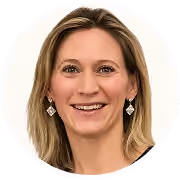
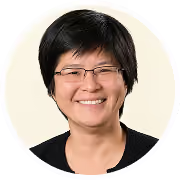


30–45 min online video consultation
Review of your medical history and personal fertility goals
Expert guidance on all available treatment options
Personalised treatment plan
Price
£175
If you'd like to expedite your appointment or have any questions for us before booking, you can reach us directly via WhatsApp
45 min online video consultation
Review of your medical history and personal fertility goals
Expert guidance on all available treatment options
Personalised treatment plan
Price
£175
£300
If you'd like to expedite your appointment or have any questions for us before booking, you can reach us directly via WhatsApp
Speak to our senior nurse or fertility coordinator
15 min online video consultation
Initial guidance on our approach and treatments
Treatment options overview and next steps
Price
£0
Price
£0
Dr Sami Almusawa
Medical Director and Leading Fertility Consultant
45 min online video consultation
Review of your medical history and personal fertility goals
Expert guidance on all available treatment options
Personalised treatment plan
Price
£166.25 £175
If you'd like to expedite your appointment or have any questions for us before booking, you can reach us directly via WhatsApp
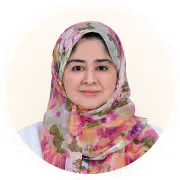
Free consultation with our speciality doctor
15 min online video consultation
Initial guidance on our approach and treatments
Treatment options overview and next steps
Price
£0
Price
£0
Dr. Nora Sahly
Speciality Doctor in Fertility, Sexual and Reproductive Health
45 min online video consultation
Review of your medical history and personal fertility goals
Expert guidance on all available treatment options
Personalised treatment plan
Price
£175

.avif)
.avif)

.webp)
.webp)